
guide
Understanding Insurance Deductibles for Business Equipment
Learn how equipment insurance deductibles work, including per-occurrence, per-item, percentage, waiting-period, and aggregate structures.

Introduction
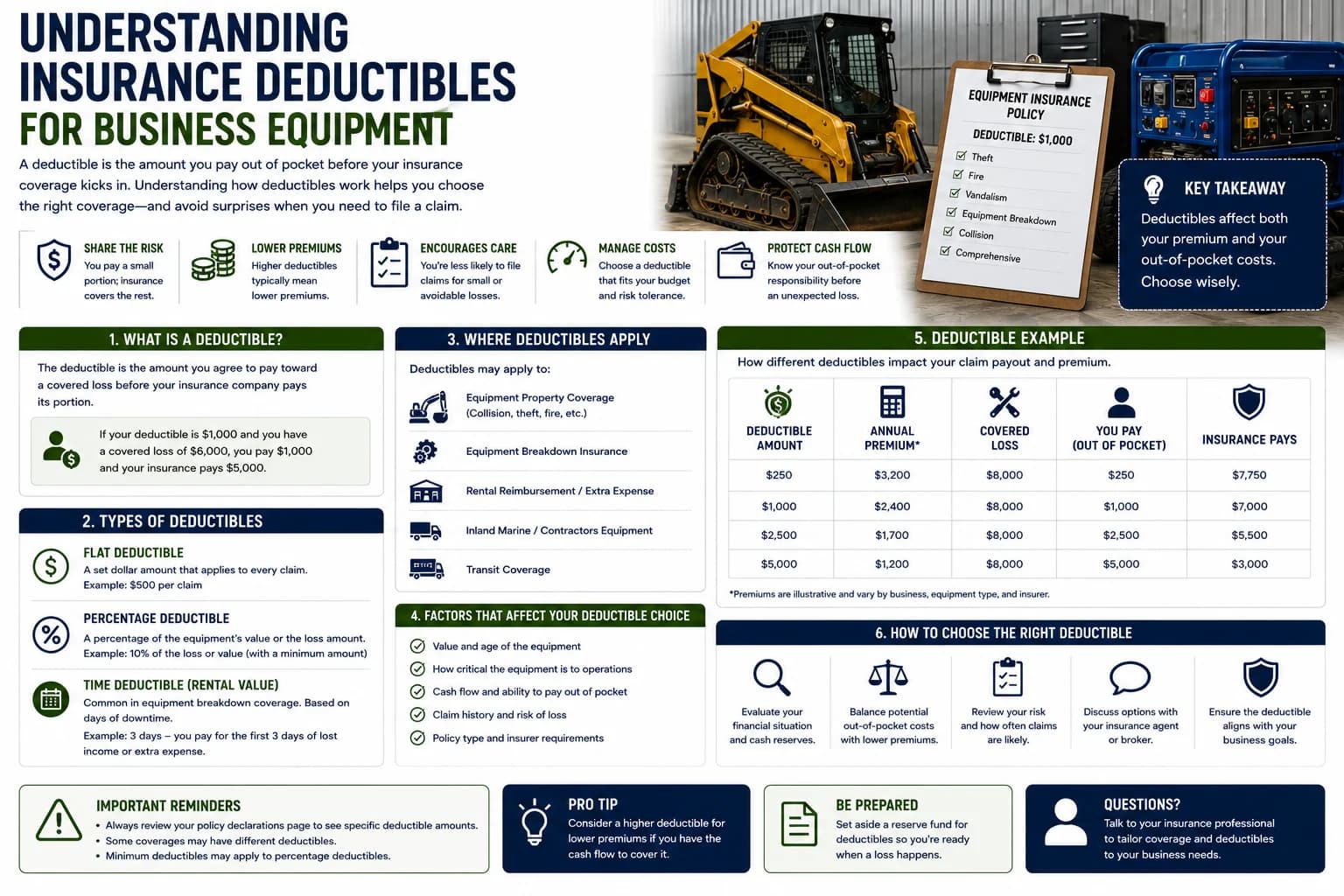
An insurance deductible is the portion of a covered loss the policyholder is generally responsible for before insurance payment is calculated. For equipment owners, the deductible can influence premiums, claim decisions, cash flow, and the practical value of coverage.
Deductibles are not always a simple flat dollar amount. Equipment policies may use different structures for property damage, theft, catastrophe losses, or business interruption.
This article is general educational information. Policy wording controls how a deductible applies. Consult a licensed insurance professional.
What Is an Insurance Deductible?
A deductible is an amount or period applied to a covered claim according to the policy.
Example:
- Covered repair cost: $12,000
- Deductible: $2,000
- Potential insurer payment before other adjustments: $10,000
Actual settlement can also be affected by limits, depreciation, coinsurance, exclusions, and valuation terms.
Common Deductible Structures
Per-Occurrence Deductible
One deductible may apply to all covered damage arising from a single occurrence.
Per-Item Deductible
A separate deductible may apply to each damaged or stolen asset.
Percentage Deductible
The deductible may be a percentage of the insured value or loss, particularly for certain catastrophe risks.
Waiting Period
Business income or service interruption coverage may use a waiting period instead of, or in addition to, a dollar deductible.
Aggregate Deductible
Some policies use an annual aggregate structure across multiple losses.
How Deductibles Affect Premiums
Higher deductibles often reduce premiums because the business retains more risk.
However, a lower premium is not automatically the best choice.
Consider:
- Typical repair costs
- Value of individual assets
- Frequency of small losses
- Available emergency cash
- Number of locations
- Theft exposure
- Catastrophe exposure
The deductible should be affordable during a difficult event.
Deductibles and Small Claims
If damage is close to or below the deductible, filing a claim may provide little or no payment.
Before deciding, businesses should:
- Estimate the complete loss
- Check for hidden damage
- Review reporting obligations
- Consider related property damage
- Ask the insurer or agent about notification requirements
Do not assume a loss is too small until the full scope is understood.
One Event or Multiple Events?
The number of deductibles may depend on how the policy defines an occurrence.
For example, a storm damaging equipment at several locations may be treated differently from unrelated thefts occurring on different dates.
Businesses should document:
- Date and time
- Location
- Cause
- Assets affected
- Sequence of events
This information helps the insurer evaluate how the deductible applies.
Different Deductibles Within One Policy
A policy may have different deductibles for:
- Theft
- Wind or hail
- Flood
- Earthquake
- Equipment breakdown
- Mobile equipment
- Business income
The declarations and endorsements should be reviewed together.
Choosing a Deductible
Questions to consider:
- Could the business pay this amount immediately?
- How many assets could be involved in one event?
- Does the deductible apply per item or occurrence?
- Are high-value assets subject to different terms?
- How much premium savings does a higher deductible provide?
- Would frequent small losses remain uninsured?
The choice should reflect both risk tolerance and cash reserves.
Deductible Review Checklist
Record:
- Deductible amount
- Deductible type
- Covered equipment category
- Per-item or per-occurrence application
- Catastrophe deductibles
- Waiting periods
- Annual aggregates
- Emergency cash plan
- Renewal changes
Policy summaries should be stored with the full policy, not used as a substitute for it.
Conclusion
Insurance deductibles determine how much equipment risk a business keeps for itself. Understanding whether a deductible is flat, percentage-based, per item, per occurrence, or time-based helps owners estimate the real financial effect of a loss.
Review deductibles alongside equipment values, likely repair costs, and available cash so coverage remains useful when it is needed.