
guide
Preventing Equipment Loss: Strategies Every Business Should Implement
Learn practical strategies to prevent equipment loss with asset tracking, check-out procedures, audits, secure storage, and accountability.

Introduction
Equipment is one of the most significant investments many businesses make. Whether it's heavy machinery, tools, vehicles, medical devices, technology equipment, or specialized assets, every piece of equipment represents both operational value and financial investment.
Unfortunately, equipment loss remains a common challenge across industries. Equipment can be misplaced, stolen, damaged, improperly assigned, or simply disappear due to poor record keeping. Even small losses can accumulate into substantial costs over time.
Preventing equipment loss requires more than simply locking equipment away. It requires a combination of asset tracking, accountability, inventory controls, security measures, and organizational procedures.
This guide explores practical strategies businesses can implement to reduce equipment loss, improve accountability, and protect valuable assets.
Understanding Equipment Loss
Equipment loss does not always involve theft.
In many organizations, lost equipment results from:
- Poor tracking procedures
- Inaccurate records
- Unauthorized transfers
- Employee turnover
- Improper storage
- Lack of accountability
- Incomplete inventory audits
Without proper controls, businesses often discover missing equipment months or even years after it disappears.
By that point, recovery becomes difficult or impossible.
The True Cost of Equipment Loss
Many businesses only consider the replacement cost of lost equipment.
However, the actual impact is often much greater.
Equipment loss can lead to:
- Replacement expenses
- Project delays
- Operational downtime
- Reduced productivity
- Increased insurance costs
- Compliance concerns
- Customer service disruptions
A missing piece of equipment can affect multiple areas of the business simultaneously.
Preventing loss is usually far less expensive than replacing assets.
Create a Complete Asset Inventory
The foundation of equipment loss prevention is maintaining an accurate inventory.
Every asset should have a record that includes:
- Asset ID
- Equipment name
- Category
- Manufacturer
- Model number
- Serial number
- Purchase date
- Purchase cost
- Assigned location
- Responsible employee
- Current status
Organizations cannot effectively protect equipment they do not know they own.
Accurate inventory records create visibility and accountability.
Assign Unique Asset Identifiers
Every piece of equipment should have a unique identifier.
Examples include:
- EQ-1001
- TOOL-2547
- VEH-0035
- CNC-0089
Unique identifiers help businesses:
- Track ownership
- Monitor movement
- Conduct audits
- Investigate missing equipment
Consistent identification reduces confusion and improves record accuracy.
Label Equipment Properly
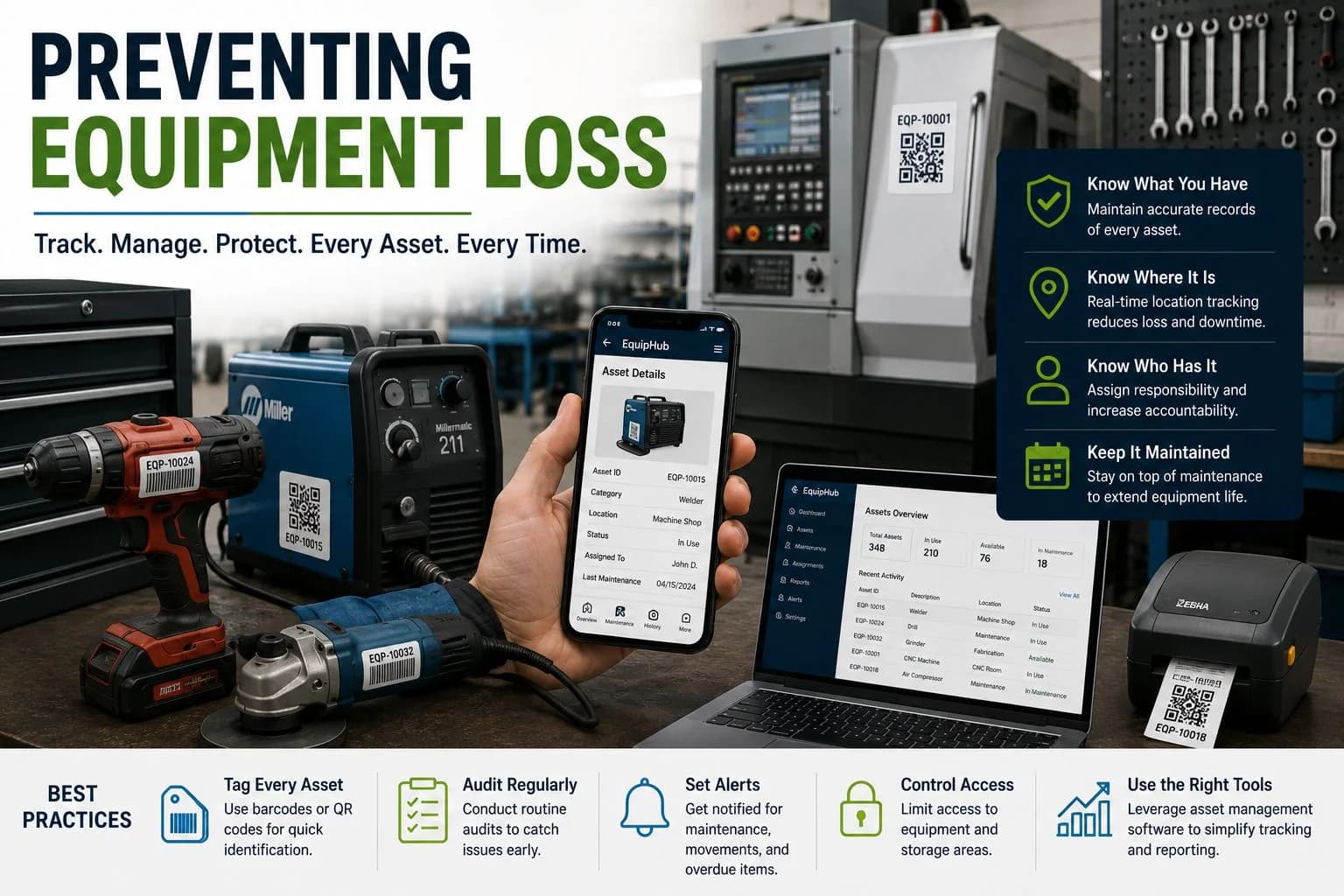
Asset labels provide a direct link between physical equipment and inventory records.
Common labeling methods include:
Barcode Labels
Ideal for basic inventory tracking.
QR Code Labels
Allow employees to quickly access equipment records, maintenance history, and assignment information using smartphones.
Labels should be:
- Durable
- Weather resistant
- Easy to scan
- Clearly visible
Damaged or missing labels should be replaced immediately.
Establish Equipment Check-Out Procedures
Many equipment losses occur because equipment is borrowed without documentation.
Implement a formal check-out process.
Record:
- Asset ID
- Employee name
- Date issued
- Expected return date
- Equipment condition
When equipment is returned, document:
- Return date
- Condition
- Any damage
A documented chain of custody significantly improves accountability.
Assign Ownership and Responsibility
Every asset should have a designated responsible party.
Examples include:
- Individual employee
- Department manager
- Site supervisor
- Project manager
Assigned responsibility helps ensure equipment receives proper care and attention.
Employees are generally more likely to protect equipment when accountability is clearly defined.
Control Equipment Transfers
Equipment frequently moves between:
- Departments
- Buildings
- Job sites
- Vehicles
- Employees
Every transfer should be documented.
Transfer records should include:
- Asset ID
- Previous location
- New location
- Transfer date
- Authorized personnel
Unrecorded transfers are one of the leading causes of inventory inaccuracies.
Conduct Regular Inventory Audits
Inventory audits help identify problems before they become significant losses.
Audits should verify:
- Equipment location
- Asset status
- Assigned ownership
- Equipment condition
- Inventory accuracy
Audit frequency may vary depending on equipment value and operational requirements.
Common schedules include:
- Monthly
- Quarterly
- Annually
High-value equipment often benefits from more frequent verification.
Improve Equipment Storage Practices
Poor storage procedures contribute to both loss and damage.
Best practices include:
Designated Storage Areas
Clearly define where equipment belongs.
Restricted Access
Limit access to authorized personnel.
Organized Layouts
Maintain orderly storage systems.
Secure Facilities
Use locks, access controls, and surveillance where appropriate.
Proper storage reduces the likelihood of misplaced equipment.
Use Technology to Improve Visibility
Modern asset management systems provide significantly better visibility than manual methods.
Technology can help businesses:
- Track asset locations
- Monitor assignments
- Record transfers
- Schedule audits
- Maintain maintenance histories
Digital systems reduce human error and improve accountability.
Monitor High-Risk Equipment
Not all assets face the same level of risk.
High-risk equipment may include:
- Portable tools
- Laptops and tablets
- Vehicles
- Specialized equipment
- High-value machinery
These assets often require additional monitoring and verification.
Organizations should prioritize loss prevention efforts where risk is highest.
Develop Employee Accountability Policies
Employees play a critical role in protecting company assets.
Policies should clearly define:
- Equipment usage expectations
- Check-out procedures
- Reporting requirements
- Return responsibilities
- Consequences for negligence
Clear expectations reduce misunderstandings and improve compliance.
Train Employees on Asset Management Procedures
Even the best systems fail if employees do not understand them.
Training should cover:
- Equipment handling
- Asset tracking procedures
- Reporting requirements
- Transfer processes
- Inventory responsibilities
Consistent training improves adoption and reduces mistakes.
Require Immediate Reporting of Missing Equipment
Time is critical when equipment goes missing.
Employees should be required to report:
- Missing assets
- Suspected theft
- Damaged labels
- Unauthorized transfers
Early reporting increases the likelihood of recovery and investigation.
Analyze Loss Trends
Organizations should track equipment loss incidents over time.
Analyze:
- Types of equipment frequently lost
- Locations with recurring issues
- Common causes
- Responsible departments
Trend analysis helps identify weaknesses and prioritize corrective actions.
Common Causes of Equipment Loss
Understanding common causes can help prevent future incidents.
Lack of Tracking
No formal inventory system exists.
Poor Record Keeping
Inventory data becomes outdated.
Uncontrolled Transfers
Equipment moves without documentation.
Inadequate Storage
Assets are stored in unsecured locations.
Employee Turnover
Equipment is not recovered when employees leave.
Missing Audits
Problems remain undetected for long periods.
Addressing these issues often produces immediate improvements.
Equipment Loss Prevention Checklist
An effective prevention program should include:
- Complete equipment inventory
- Unique asset IDs
- Asset labels
- Check-out procedures
- Assignment tracking
- Transfer documentation
- Regular audits
- Secure storage
- Employee accountability
- Staff training
- Incident reporting procedures
- Asset management software
Together, these controls create a strong foundation for asset protection.
Benefits of Effective Loss Prevention
Organizations that successfully reduce equipment loss often experience:
Lower Replacement Costs
Fewer assets need replacement.
Increased Productivity
Employees spend less time searching for equipment.
Better Inventory Accuracy
Records remain current and reliable.
Improved Accountability
Responsibilities are clearly defined.
Stronger Operational Control
Managers gain better visibility into asset usage and availability.
Conclusion
Preventing equipment loss is not a single action but an ongoing process that combines technology, procedures, accountability, and regular verification. Businesses that implement strong asset management practices significantly reduce losses while improving operational efficiency and equipment utilization.
By maintaining accurate records, assigning responsibility, conducting regular audits, controlling transfers, and using modern tracking tools, organizations can protect their investments and ensure equipment remains available when it is needed most.
A proactive approach to loss prevention not only saves money but also strengthens overall equipment management across the entire organization.