
guide
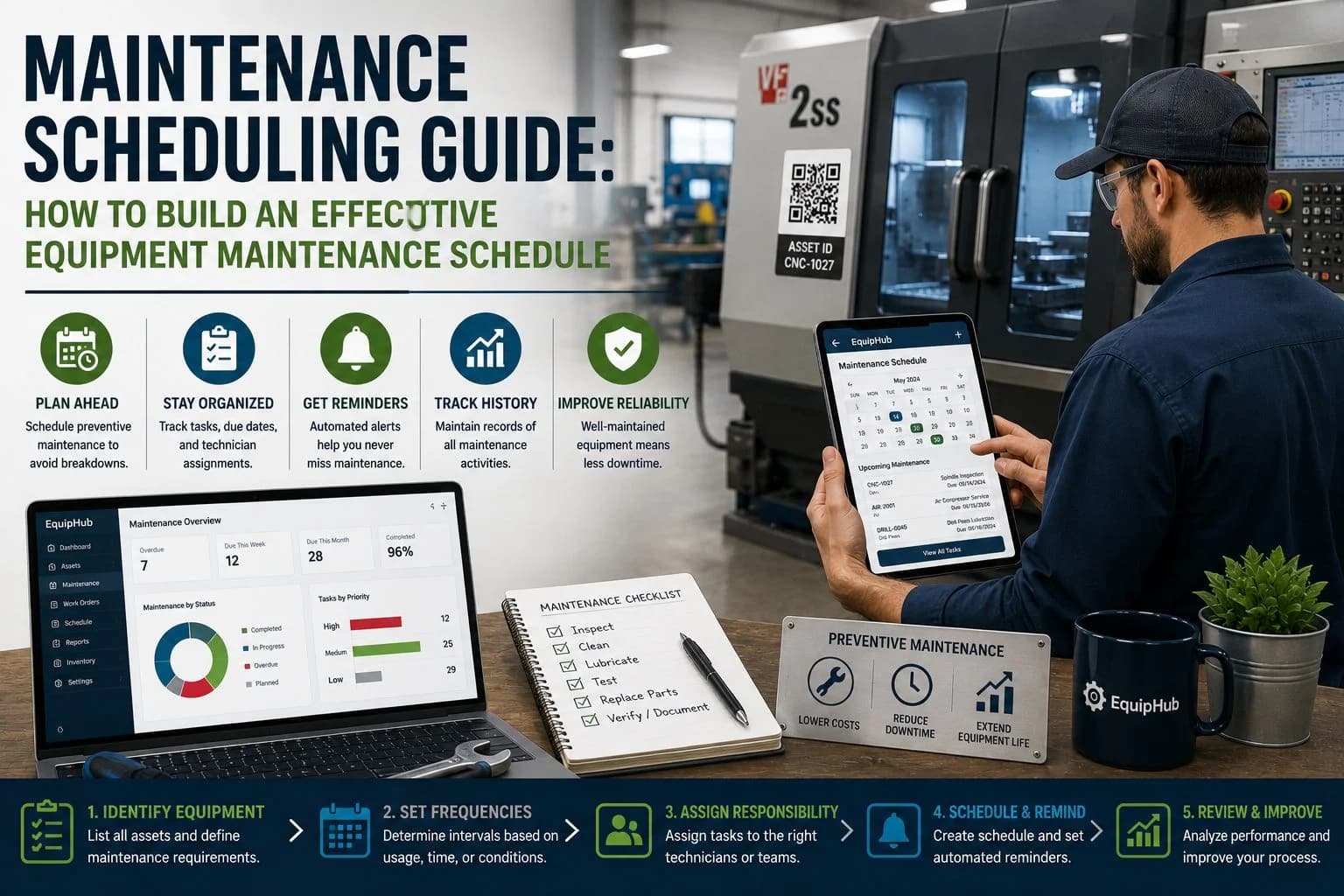
Maintenance Scheduling Guide: How to Build an Effective Equipment Maintenance Schedule
Learn how to build an effective equipment maintenance schedule that reduces downtime, lowers repair costs, improves safety, and extends asset life.

Introduction
Equipment maintenance is one of the most important responsibilities in any asset-intensive business. Whether managing construction equipment, manufacturing machinery, fleet vehicles, landscaping tools, medical devices, or facility assets, maintenance directly impacts productivity, reliability, safety, and operating costs.
However, maintenance only works when it is properly planned and consistently executed. Without a structured maintenance schedule, organizations often find themselves reacting to equipment failures instead of preventing them.
A maintenance schedule provides a roadmap for inspections, servicing, repairs, and preventive maintenance activities. It ensures that equipment receives the attention it needs at the right time while helping organizations avoid costly downtime and unexpected failures.
This guide explains how to build, manage, and optimize an effective maintenance schedule for your business.
What Is a Maintenance Schedule?
A maintenance schedule is a documented plan that outlines when maintenance activities should be performed on equipment and assets.
The schedule identifies:
- What equipment requires maintenance
- What tasks need to be performed
- When maintenance should occur
- Who is responsible
- How maintenance is documented
A maintenance schedule helps organizations move from reactive repairs to proactive asset management.
Why Maintenance Scheduling Matters
Many equipment failures are preventable.
Without a maintenance schedule, businesses often experience:
- Unexpected breakdowns
- Increased repair costs
- Reduced equipment lifespan
- Safety concerns
- Missed inspections
- Lower productivity
A structured schedule helps ensure maintenance activities occur consistently and on time.
Benefits of Maintenance Scheduling
Reduced Equipment Downtime
Scheduled maintenance helps identify issues before they result in equipment failure.
Benefits include:
- Fewer breakdowns
- More predictable operations
- Improved reliability
Reliable equipment supports consistent productivity.
Lower Maintenance Costs
Planned maintenance is generally less expensive than emergency repairs.
Scheduling allows businesses to:
- Order parts in advance
- Plan labor resources
- Avoid urgent service calls
Preventive maintenance often costs significantly less than major repairs.
Extended Equipment Lifespan
Regular maintenance reduces wear and prevents unnecessary damage.
Properly maintained equipment often remains productive for years longer than neglected equipment.
Improved Safety
Maintenance schedules ensure that safety inspections and repairs occur regularly.
This helps reduce:
- Equipment-related accidents
- Regulatory violations
- Workplace hazards
Safety improvements benefit both employees and operations.
Better Budget Planning
Scheduled maintenance provides predictable maintenance costs.
Organizations can plan for:
- Labor expenses
- Parts purchases
- Service contracts
- Equipment replacement
Predictable costs improve financial planning.
Types of Maintenance Schedules
Different scheduling methods may be appropriate depending on the equipment and operational environment.
Time-Based Scheduling
Maintenance occurs at predetermined intervals.
Examples:
- Weekly inspections
- Monthly servicing
- Quarterly maintenance
- Annual inspections
Time-based scheduling is simple and widely used.
Usage-Based Scheduling
Maintenance occurs after equipment reaches a specific usage threshold.
Examples:
- Every 250 operating hours
- Every 5,000 miles
- Every 1,000 production cycles
This method aligns maintenance with actual equipment use.
Condition-Based Scheduling
Maintenance is triggered when equipment shows signs of wear or performance decline.
Examples include monitoring:
- Temperature
- Vibration
- Oil quality
- Pressure readings
Condition-based maintenance can reduce unnecessary servicing while preventing failures.
Manufacturer-Based Scheduling
Manufacturers often provide recommended maintenance intervals.
These recommendations typically include:
- Inspection schedules
- Fluid changes
- Component replacements
- Safety checks
Following manufacturer guidelines helps maintain performance and warranty coverage.
Building a Maintenance Schedule
Creating a maintenance schedule requires planning and organization.
Step 1: Create an Equipment Inventory
Start by identifying all equipment requiring maintenance.
Inventory records should include:
- Asset ID
- Equipment name
- Manufacturer
- Model number
- Serial number
- Location
- Purchase date
A complete inventory serves as the foundation for scheduling.
Step 2: Categorize Equipment
Not all assets require the same level of maintenance.
Categories may include:
- Heavy equipment
- Vehicles
- Machinery
- Tools
- Facility assets
- Technology equipment
Grouping assets helps simplify maintenance planning.
Step 3: Identify Critical Assets
Some equipment is more important than others.
Critical assets may:
- Generate revenue
- Support production
- Impact safety
- Cause significant downtime if they fail
Critical equipment should receive priority attention.
Step 4: Determine Maintenance Requirements
Review:
- Manufacturer recommendations
- Maintenance manuals
- Historical repair records
- Operating conditions
Document required maintenance tasks for each asset.
Step 5: Establish Maintenance Frequencies
Determine how often maintenance should occur.
Examples:
- Daily inspections
- Weekly cleaning
- Monthly servicing
- Quarterly testing
- Annual overhauls
Maintenance frequency should balance reliability and cost.
Step 6: Assign Responsibilities
Every maintenance task should have an assigned owner.
Responsibilities may be assigned to:
- Maintenance technicians
- Operators
- Supervisors
- Third-party service providers
Clear accountability improves execution.
Common Maintenance Schedule Intervals
Many organizations use a combination of intervals.
Daily Tasks
Examples:
- Visual inspections
- Fluid level checks
- Safety inspections
- Cleaning
Daily checks help identify obvious issues quickly.
Weekly Tasks
Examples:
- Lubrication
- Battery inspections
- Tire checks
- Equipment cleaning
Weekly maintenance supports ongoing reliability.
Monthly Tasks
Examples:
- Detailed inspections
- Filter checks
- Calibration verification
- Operational testing
Monthly activities often identify developing issues.
Quarterly Tasks
Examples:
- Component inspections
- Performance evaluations
- Safety system testing
Quarterly maintenance helps maintain long-term reliability.
Annual Tasks
Examples:
- Major servicing
- Comprehensive inspections
- Equipment overhauls
- Compliance inspections
Annual maintenance supports lifecycle management.
Maintenance Schedule Example
A preventive maintenance schedule for a skid steer loader may look like:
Daily
- Check fluid levels
- Inspect tires
- Verify safety systems
Weekly
- Lubricate moving parts
- Inspect hydraulic hoses
- Clean air intake systems
Monthly
- Replace filters if needed
- Inspect battery connections
- Check operating performance
Quarterly
- Inspect hydraulic system
- Test safety controls
- Review maintenance history
Annually
- Full service inspection
- Replace wear components
- Update maintenance records
This structured approach reduces the likelihood of unexpected failures.
Documenting Maintenance Activities
Maintenance schedules are only valuable when activities are documented.
Maintenance records should include:
- Asset ID
- Maintenance date
- Tasks completed
- Technician name
- Parts used
- Notes and observations
Accurate records improve visibility and planning.
Managing Maintenance Backlogs
Maintenance tasks occasionally fall behind schedule.
When this occurs:
Prioritize Critical Equipment
Address maintenance for critical assets first.
Evaluate Risk
Determine whether delayed maintenance creates safety or operational concerns.
Reallocate Resources
Adjust staffing or scheduling if necessary.
Update Schedules
Maintain accurate records of completed and overdue tasks.
Ignoring maintenance backlogs can increase equipment risk.
Common Maintenance Scheduling Mistakes
Organizations should avoid:
Over-Scheduling
Too much maintenance can waste labor and increase costs.
Under-Scheduling
Insufficient maintenance increases the likelihood of failures.
Ignoring Manufacturer Recommendations
Manufacturer guidelines often provide valuable maintenance insights.
Poor Documentation
Missing records reduce visibility and accountability.
Lack of Follow-Through
Creating schedules is not enough; tasks must actually be completed.
Best Practices for Maintenance Scheduling
Successful maintenance programs typically:
- Maintain accurate asset inventories
- Prioritize critical equipment
- Follow manufacturer recommendations
- Document all maintenance activities
- Track maintenance history
- Review schedules regularly
- Assign clear responsibilities
- Conduct periodic audits
- Continuously improve processes
These practices help maximize equipment reliability and performance.
Measuring Maintenance Schedule Effectiveness
Organizations should monitor:
Equipment Downtime
Downtime should decrease as maintenance improves.
Repair Costs
Emergency repair expenses should decline over time.
Maintenance Compliance
Track whether scheduled maintenance tasks are completed on time.
Asset Lifespan
Well-maintained equipment typically remains productive longer.
Failure Rates
Equipment failures should become less frequent.
Performance metrics help evaluate and improve maintenance programs.
Conclusion
A well-designed maintenance schedule is one of the most valuable tools for protecting equipment investments. By planning inspections, servicing, and preventive maintenance activities in advance, organizations can reduce downtime, lower repair costs, improve safety, and extend asset lifespan.
Whether managing a small inventory of equipment or a large fleet of assets, consistent maintenance scheduling creates greater reliability, better operational control, and stronger long-term performance. The most successful organizations treat maintenance as a planned business process rather than a reaction to equipment failure.