
guide
Insurance Considerations for Rented and Leased Equipment
Learn how rental agreements, lease terms, responsibility for damage, loss payees, coverage limits, and equipment records affect rented and leased equipment.

Introduction
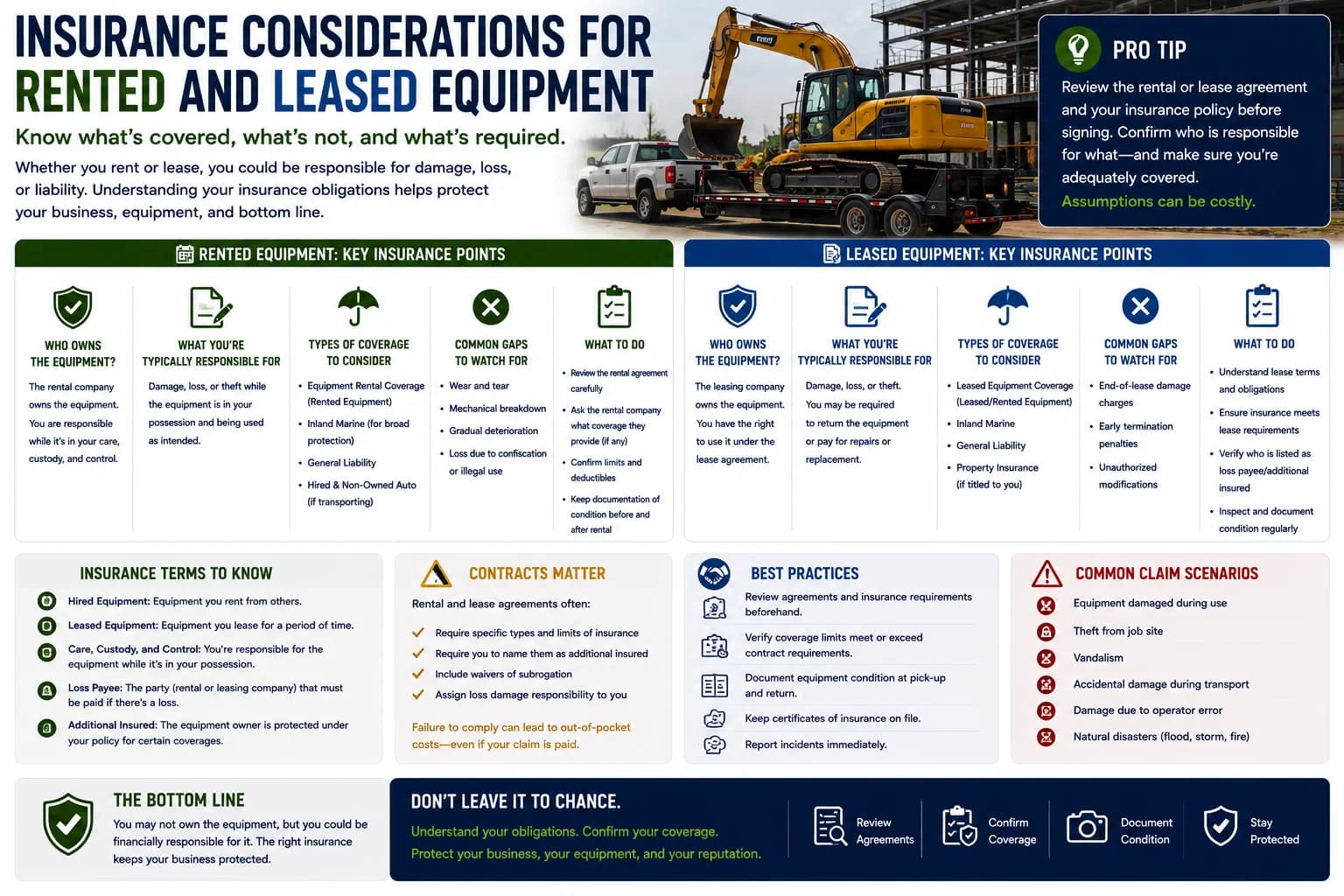
Businesses often rent or lease equipment to handle temporary projects, seasonal demand, specialized work, or major purchases. Although the business may not own the asset, it may still be financially responsible for damage, theft, loss of use, or contract obligations.
Insurance for rented and leased equipment should be reviewed before the equipment arrives, not after an incident.
This article is general educational information. Rental agreements, leases, and policies vary. Consult a licensed insurance professional and qualified counsel when needed.
Ownership and Responsibility Are Different
The rental company or lessor may own the equipment, while the customer assumes responsibility during the rental or lease term.
The contract may require the customer to pay for:
- Physical damage
- Theft
- Loss of use
- Diminished value
- Transport damage
- Cleanup
- Recovery costs
- Deductibles
Read the contract alongside the insurance policy.
Rental Company Damage Waivers
A damage waiver may reduce some contractual responsibility, but it is not necessarily insurance.
Waivers may exclude:
- Theft without required security
- Misuse
- Unauthorized operators
- Overloading
- Tire or glass damage
- Flood
- Improper transport
- Unexplained disappearance
Understand the waiver's exclusions and maximum responsibility.
Existing Business Insurance
A business policy may provide some coverage for rented equipment, but owners should confirm:
- Maximum limit
- Deductible
- Coverage territory
- Rental duration
- Equipment types
- Theft conditions
- Loss-of-use coverage
- Whether the asset must be scheduled
Do not assume owned-equipment coverage automatically extends to rentals.
Leased Equipment Requirements
Long-term leases may require:
- Specific coverage limits
- Lessor listed as loss payee
- Additional insured status where appropriate
- Proof of insurance
- Notice of cancellation
- Replacement cost coverage
- Maintenance compliance
Failure to meet insurance requirements may violate the lease.
Loss Payees and Lenders
A loss payee has a financial interest in insured equipment.
After a covered loss, payment may involve:
- Lessor
- Lender
- Business
- Repair vendor
Confirm how claims and payments are handled before signing.
Document Condition at Pickup and Return
Take photos of:
- All sides
- Serial plate
- Meter reading
- Attachments
- Existing damage
- Tires or tracks
- Controls
- Fuel level
Use a written condition report signed or acknowledged by both parties when possible.
Track Operators and Locations
Rental and lease records should include:
- Assigned employee
- Authorized operators
- Job site
- Pickup date
- Return date
- Contract number
- Current condition
- Security requirements
Unauthorized use or unreported locations may create contract or coverage issues.
Theft Prevention
Rental agreements and policies may require security measures.
Examples include:
- Locked storage
- Key control
- Immobilizers
- GPS tracking
- Fenced yards
- Approved overnight locations
- Prompt police reporting
Document how requirements are followed.
After Damage or Theft
If rented or leased equipment is damaged:
- Protect people and prevent further damage.
- Notify the rental company or lessor.
- Notify the insurer.
- Photograph the scene and equipment.
- Preserve damaged parts.
- Obtain required reports.
- Track all communications and expenses.
Do not authorize major repairs without confirming contractual and insurance procedures.
Rented and Leased Equipment Checklist
Before taking possession, confirm:
- Equipment description and serial number
- Contract responsibility
- Insurance requirement
- Damage waiver terms
- Coverage limit
- Deductible
- Loss-of-use responsibility
- Loss payee details
- Authorized operators
- Approved locations
- Security conditions
- Pickup condition photos
Keep the contract and insurance evidence with the asset record.
Conclusion
Rented and leased equipment can create significant financial responsibility even when the business does not own the asset. Contract terms, insurance coverage, damage waivers, security requirements, and loss-of-use obligations should be reviewed together.
Clear condition records and assignment history help protect both the business and the equipment provider throughout the rental or lease.