
guide
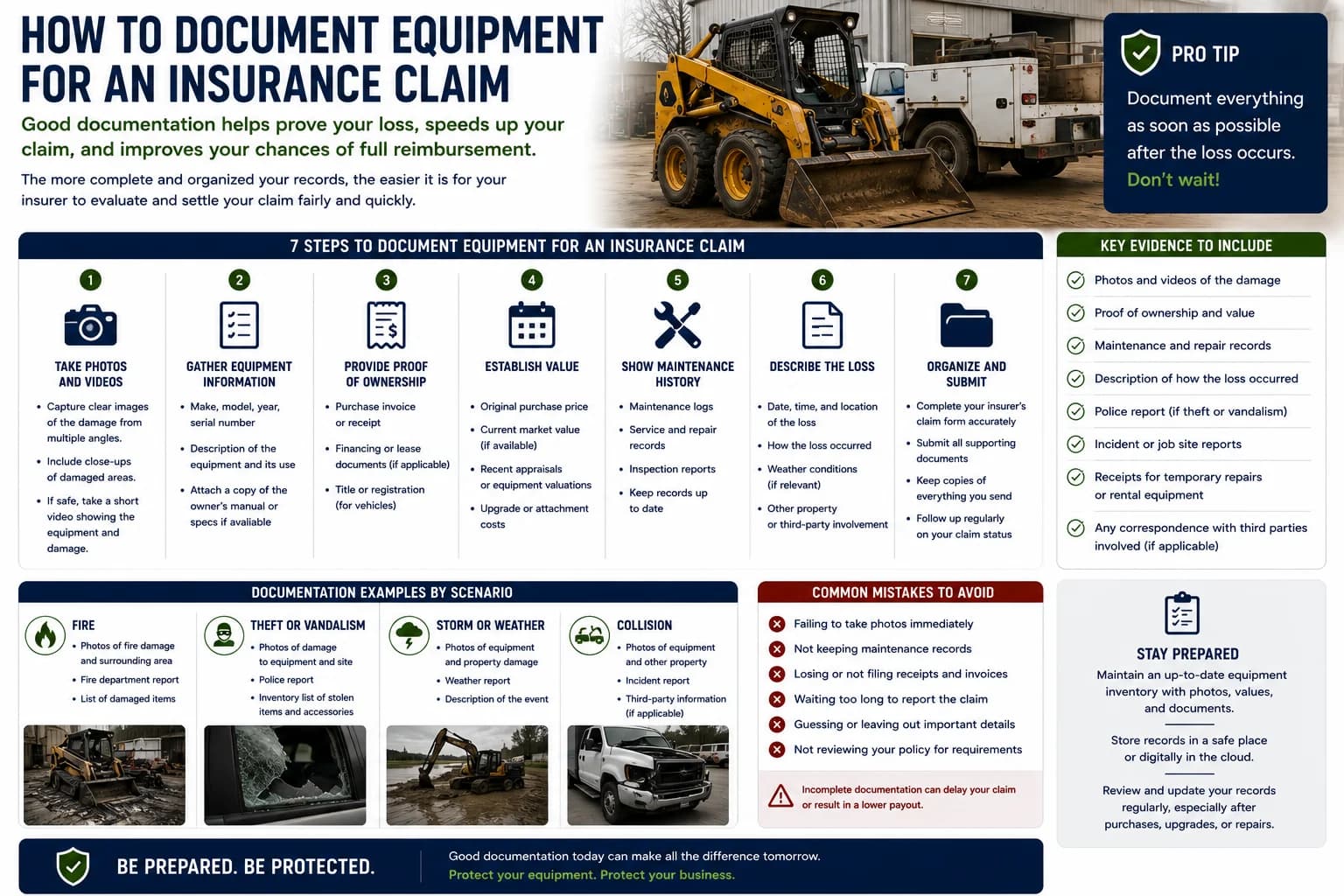
How to Document Equipment for an Insurance Claim
Learn how to prepare equipment records before a loss and document damage, ownership, condition, costs, and communications during an insurance claim.

Introduction
An insurance claim is easier to evaluate when equipment records already exist. After a theft, fire, storm, breakdown, or accident, owners may need to prove what equipment was involved, its condition before the event, how it was damaged, and what it will cost to repair or replace.
Trying to recreate those records after a loss can be difficult, especially if documents were stored at the damaged location.
This guide explains how to document equipment before and during an insurance claim.
Follow insurer instructions and protect personal safety. This article is general information, not insurance or legal advice.
Build Records Before a Loss
For each asset, maintain:
- Asset ID
- Equipment description
- Manufacturer
- Model
- Serial number
- Purchase date
- Purchase invoice
- Photos
- Location
- Assigned employee
- Maintenance history
- Current value estimate
Store backups away from the equipment location.
Protect People and Property First
After a loss:
- Address emergencies.
- Contact emergency services when needed.
- Prevent additional damage when safe.
- Follow site safety procedures.
- Notify the insurer or agent promptly.
Do not enter unsafe areas solely to gather evidence.
Photograph the Scene
Take wide and detailed photos when it is safe and permitted.
Capture:
- Overall scene
- Equipment location
- Damage from several angles
- Serial plate
- Asset tag
- Nearby damage
- Broken locks or entry points
- Water, debris, or burn patterns
- Damaged attachments
Avoid altering the scene more than necessary before documentation.
Write a Loss Timeline
Record:
- Date and time discovered
- Last known normal condition
- Who discovered the loss
- Where the equipment was located
- Weather or site conditions
- Events leading up to the loss
- Immediate actions taken
- People notified
Write factual observations and avoid guessing about the cause.
Preserve Damaged Equipment and Parts
The insurer may need to inspect damaged equipment.
Before disposal:
- Ask for instructions
- Preserve failed components
- Retain packaging or debris when relevant
- Document emergency repairs
- Keep replaced parts
- Record who handled the equipment
Emergency work may be necessary to prevent further damage, but it should be documented.
Gather Ownership and Value Records
Useful evidence includes:
- Purchase invoice
- Financing agreement
- Lease agreement
- Registration
- Serial number record
- Prior photos
- Maintenance invoices
- Appraisals
- Comparable replacement quotes
If original documents are missing, vendors, lenders, accountants, or service providers may have copies.
Track Repair and Replacement Costs
Keep:
- Estimates
- Diagnostic fees
- Repair invoices
- Replacement quotes
- Freight charges
- Rental equipment costs
- Cleanup expenses
- Temporary protection costs
Separate costs by asset where possible.
Maintain a Claim Communication Log
Record:
- Claim number
- Adjuster contact
- Dates of calls
- Documents submitted
- Requests received
- Inspection appointments
- Decisions and explanations
A communication log reduces confusion during a long claim.
Common Documentation Mistakes
Avoid:
- Discarding equipment too early
- Missing serial numbers
- Taking only close-up photos
- Altering the scene without documentation
- Combining unrelated expenses
- Guessing about the cause
- Losing communication history
Clear, factual records are more useful than unsupported conclusions.
Insurance Claim Documentation Checklist
Prepare:
- Asset inventory
- Proof of ownership
- Pre-loss photos
- Post-loss photos
- Serial numbers
- Loss timeline
- Police or incident report
- Repair estimates
- Replacement quotes
- Expense receipts
- Communication log
- Maintenance records
Follow the insurer's requested format and deadlines.
Conclusion
Good claim documentation connects the damaged equipment to proof of ownership, pre-loss condition, cause-of-loss evidence, and repair or replacement costs.
Businesses that maintain equipment records before a loss can respond faster and provide insurers with a clearer, more complete claim file.