
tool
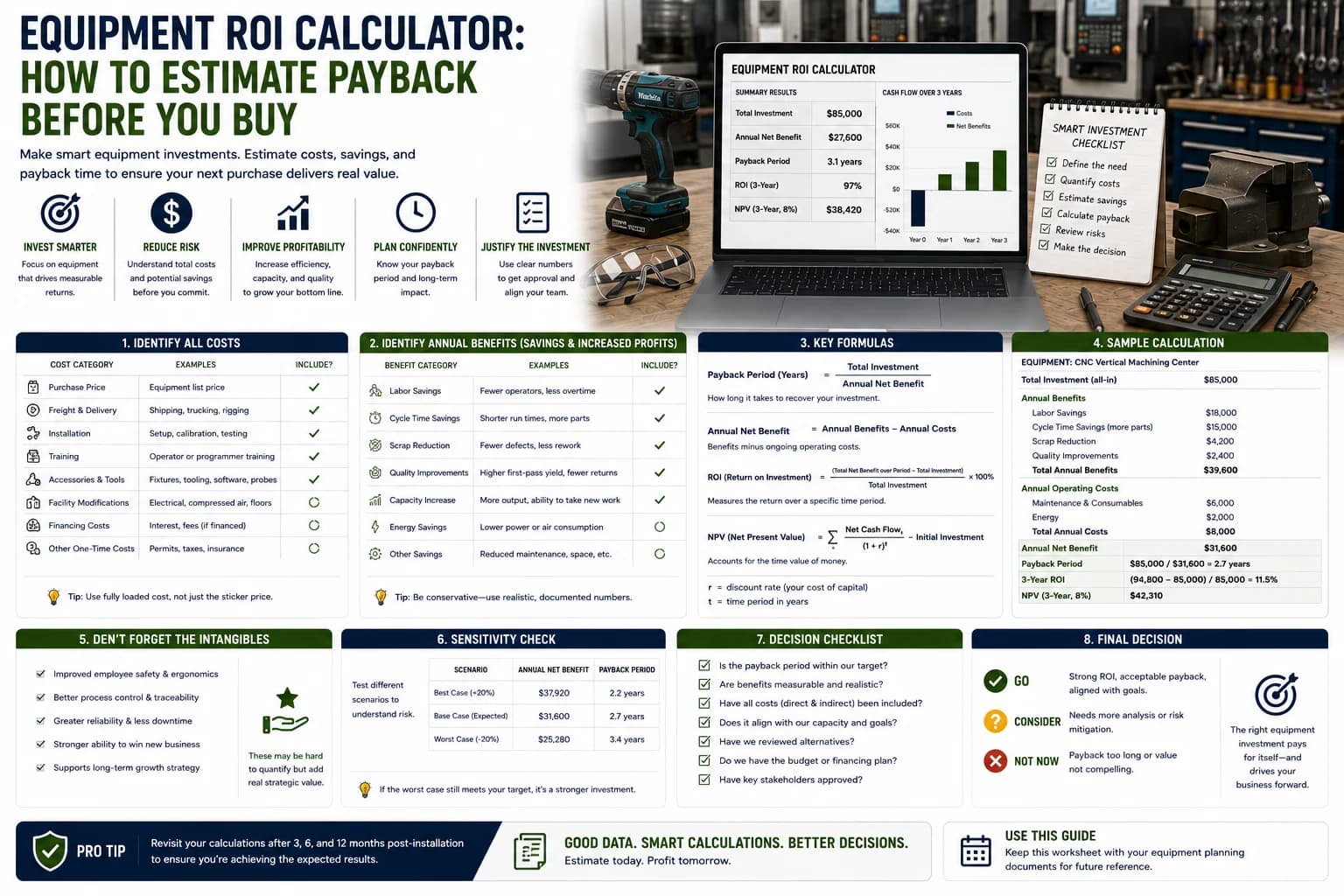
Equipment ROI Calculator: How to Estimate Payback Before You Buy
Learn how to estimate equipment ROI using purchase cost, financing, maintenance, labor savings, revenue impact, downtime reduction, and resale value.

Introduction
Before buying equipment, businesses should understand whether the investment is likely to create enough value to justify the cost. A new machine, vehicle, tool, or production asset may improve capacity, reduce labor, increase revenue, or lower downtime, but those benefits should be estimated before committing capital.
An equipment ROI calculator helps compare expected gains against total cost. It does not replace professional financial advice, but it gives owners and managers a practical framework for evaluating purchases.
This guide explains how to calculate equipment ROI and what numbers to include.
What Is Equipment ROI?
ROI stands for return on investment.
A simple formula is:
ROI = (Net gain - Total cost) / Total cost x 100
For equipment, net gain may include:
- Additional revenue
- Labor savings
- Reduced downtime
- Lower repair costs
- Improved productivity
- Resale value
Total cost should include more than the purchase price.
Why ROI Matters
Equipment purchases can improve the business, but they also create risk.
ROI analysis helps answer:
- Will the equipment pay for itself?
- How long is the payback period?
- What costs are being overlooked?
- Is buying better than leasing or renting?
- Does the asset support growth?
Good ROI estimates support better capital planning.
Step 1: Estimate Total Cost
Total cost should include all costs required to acquire and operate the equipment.
Common costs include:
- Purchase price
- Sales tax
- Delivery
- Installation
- Financing costs
- Training
- Insurance
- Maintenance
- Repairs
- Fuel or energy
- Software or subscriptions
Ignoring operating costs can make ROI look better than it really is.
Step 2: Estimate Financial Benefits
Next, estimate the value the equipment will create.
Benefits may include:
- New revenue
- Increased production capacity
- Faster job completion
- Labor savings
- Reduced outsourcing
- Lower downtime
- Fewer emergency repairs
- Improved quality
Use conservative estimates when possible.
Step 3: Calculate Payback Period
Payback period estimates how long it takes for the equipment to recover its cost.
Example:
- Total cost: $60,000
- Annual net benefit: $20,000
Payback period = 3 years
Shorter payback periods are generally easier to justify, but strategic equipment may still be valuable with a longer payback.
Step 4: Include Downtime Reduction
Downtime reduction can be a major benefit.
Estimate:
- Current downtime hours
- Cost per downtime hour
- Expected downtime reduction
- Annual savings
For critical equipment, downtime savings may be more important than direct revenue growth.
Step 5: Consider Resale Value
Some equipment retains meaningful value.
Estimate:
- Expected resale value
- Trade-in value
- Useful life
- Market demand
Resale value can improve the investment picture, especially for vehicles and heavy equipment.
Step 6: Compare Alternatives
ROI should be compared against other options.
Alternatives may include:
- Repairing existing equipment
- Renting
- Leasing
- Outsourcing
- Buying used
- Buying a smaller model
The best decision depends on total cost, flexibility, and operational need.
Common ROI Mistakes
Avoid these issues:
Counting Revenue Without Costs
New revenue usually requires labor, materials, and overhead.
Ignoring Financing
Interest and fees affect total cost.
Overestimating Utilization
Equipment that sits idle produces weaker returns.
Missing Training Costs
Employees may need time and instruction before productivity improves.
Forgetting Maintenance
Maintenance is part of ownership cost.
Equipment ROI Checklist
Before purchasing, estimate:
- Total acquisition cost
- Financing cost
- Operating cost
- Maintenance cost
- Expected revenue gain
- Labor savings
- Downtime savings
- Resale value
- Payback period
- Main risks
A clear estimate makes capital decisions easier to defend.
Conclusion
An equipment ROI calculator helps businesses evaluate purchases with more discipline. By considering total cost, expected gains, downtime savings, operating expenses, and alternatives, owners can make better equipment investment decisions.
ROI is not the only factor, but it is a useful tool for separating necessary purchases from assumptions that need more review.