
guide
Commercial Property Insurance vs Equipment Insurance
Compare commercial property insurance with equipment-focused coverage, including location limits, mobile assets, breakdowns, exclusions, and documentation needs.

Introduction
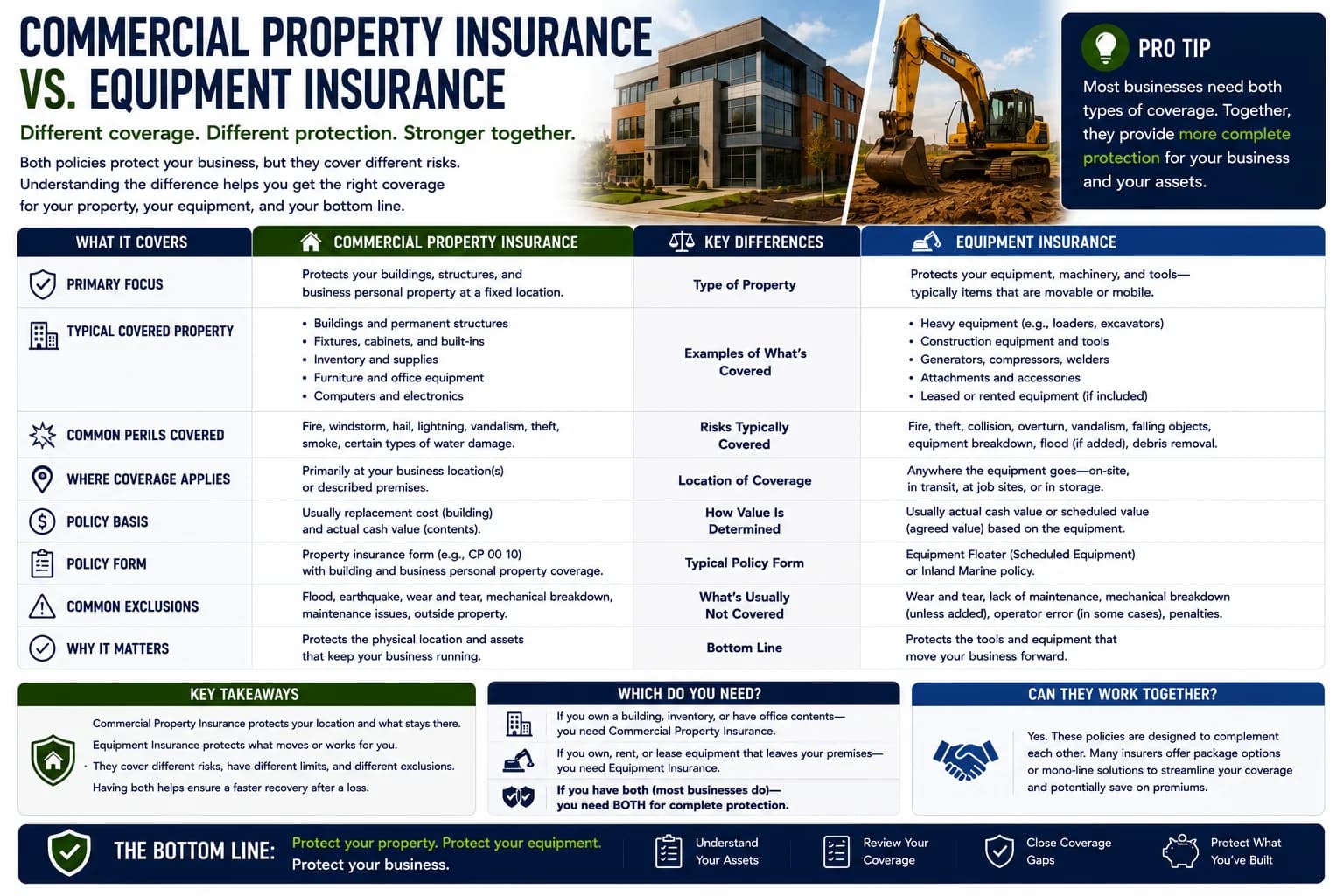
Business owners often assume commercial property insurance protects every tool, machine, and piece of equipment wherever it is used. In reality, equipment that moves between job sites, travels in vehicles, is rented, or fails internally may need different coverage.
Understanding the difference between commercial property insurance and equipment-focused coverage helps businesses identify potential gaps before a loss occurs.
This article provides general educational information. Policy terms vary. Consult a licensed insurance professional and rely on your policy documents for coverage decisions.
What Is Commercial Property Insurance?
Commercial property insurance generally protects covered business property at insured premises against specified causes of loss.
Covered property may include:
- Buildings
- Furniture
- Inventory
- Computers
- Machinery
- Equipment kept at the location
- Tenant improvements
The policy may cover risks such as fire, theft, wind, or vandalism, subject to exclusions and limits.
What Is Equipment Insurance?
"Equipment insurance" can refer to several forms of coverage designed for specific equipment risks.
Examples include:
- Inland marine coverage
- Contractor's equipment coverage
- Tools and equipment coverage
- Equipment breakdown coverage
- Rented equipment coverage
These policies or endorsements may address mobile property, specialized machinery, internal breakdowns, or equipment outside the main premises.
The Main Difference: Where and How Equipment Is Used
Commercial property coverage is often tied closely to insured locations.
Equipment-focused coverage may be designed for assets that:
- Move between job sites
- Travel in service vehicles
- Remain temporarily at customer locations
- Are stored away from the main premises
- Are rented or leased
- Face internal mechanical or electrical breakdown
Businesses should map actual equipment movement against the policy's coverage territory.
Mobile Equipment and Inland Marine Coverage
Mobile tools and equipment may not fit neatly into premises-based property coverage.
Inland marine coverage is commonly used for movable property such as:
- Contractor tools
- Construction equipment
- Surveying equipment
- Mobile diagnostic devices
- Equipment in transit
The name can be confusing, but the coverage is not limited to marine operations.
Equipment Breakdown Coverage
Commercial property insurance may cover external events such as fire or storm damage, but it may not cover certain internal failures.
Equipment breakdown coverage may address covered losses caused by:
- Electrical arcing
- Mechanical breakdown
- Pressure-system failure
- Certain control-system failures
Wear and tear, poor maintenance, and gradual deterioration are commonly treated differently.
Valuation and Limits
Both commercial property and equipment policies may use:
- Replacement cost
- Actual cash value
- Agreed value
- Scheduled values
Businesses should also review:
- Per-item limits
- Blanket limits
- Sublimits
- Coinsurance provisions
- Deductibles
An equipment inventory helps determine whether declared limits reflect actual exposure.
Example Coverage Questions
Consider a contractor whose tools are stolen from a locked trailer at a job site.
Questions may include:
- Is the job site within the coverage territory?
- Are tools away from the insured premises covered?
- Does a theft sublimit apply?
- Were required security measures followed?
- Is the trailer itself covered separately?
The answers depend on policy wording, not the general policy name.
Common Coverage Gaps
Potential gaps include:
- Equipment away from scheduled premises
- Tools left in vehicles overnight
- Rented or borrowed equipment
- Flood or earthquake damage
- Internal mechanical breakdown
- Newly purchased equipment not reported
- Values that have not been updated
- High-value assets exceeding sublimits
An annual review should compare policy coverage with current operations.
Documentation Checklist
Maintain:
- Equipment inventory
- Serial numbers
- Purchase invoices
- Photos
- Current locations
- Replacement values
- Rental or lease agreements
- Maintenance records
- Security procedures
These records help insurance professionals recommend coverage and support future claims.
Conclusion
Commercial property insurance and equipment-focused coverage serve related but different purposes. Property insurance may protect equipment at insured premises, while specialized coverage may address mobile assets, internal breakdowns, rentals, or other exposures.
Business owners should avoid relying on policy labels alone. Review where equipment goes, how it is used, what could damage it, and whether the policy responds to those specific circumstances.